Battambang
Battambang: Cambodia’s Countryside Capital
Battambang sits along the Sangker River in northwestern Cambodia, roughly 170 kilometers from Siem Reap and 290 kilometers from Phnom Penh. This is Cambodia’s second-largest city, though calling it a “city” overstates its urban character. Battambang feels more like an oversized provincial town: French colonial architecture, tree-lined riverside streets, agricultural economy centered on rice production, and a pace that’s deliberately slower than Phnom Penh or Siem Reap.
What makes Battambang appealing is exactly this understated quality. It’s Cambodia without the tourist intensity, showing ordinary provincial life, colonial heritage, and countryside access without the crowds or commercialization that define Cambodia’s main tourist destinations.
The Colonial Architecture
Battambang contains Cambodia’s best-preserved French colonial buildings outside Phnom Penh. The town prospered during French rule as a rice trading center, and wealthy merchants built elegant shophouses and villas.
Walk along the riverside (Street 1) and through the old quarter. You’ll see two and three-story shophouses with shuttered windows, decorative facades, and covered arcades. Many are deteriorating, some have been restored, others are occupied by businesses operating much as they have for decades.
The Governor’s Residence, colonial-era bank buildings, and several administrative structures show French architecture adapted to tropical conditions. These aren’t museums or attractions with entry fees. They’re functioning buildings you observe while walking through town.
The architectural appeal is cumulative rather than spectacular. No single building rivals Phnom Penh’s best examples, but the concentration across several blocks creates an atmosphere that’s increasingly rare in developing Cambodia.
The Bamboo Train (Norry)
The bamboo train is Battambang’s most famous attraction, though “attraction” makes it sound more substantial than it is. Originally, these were improvised vehicles locals created during years when Cambodia’s rail system was non-functional: bamboo platforms with small motors, running on railway tracks.
The original norry served genuine transport needs, carrying people and goods between villages. As the railway was rebuilt, the bamboo trains were pushed out except for one tourist section about 7 kilometers outside Battambang.
Now it’s purely a tourist experience: you ride the bamboo platform about 4 kilometers to a small station, disembark briefly, then return. When trains meet going opposite directions on the single track, one is disassembled and lifted off to let the other pass, then reassembled.
It’s mildly interesting, somewhat fun in a quirky way, but definitely manufactured for tourism rather than authentic transport. Kids enjoy it. Adults find it amusing for 20 minutes. Cost is around $5 USD per person.
If you go, manage expectations. This is a brief novelty ride, not a significant cultural experience. Some travelers love it, others feel it’s tourist theater that should be skipped.
Phnom Sampeau and the Killing Caves
This limestone hill sits about 12 kilometers southwest of Battambang. At the summit: Buddhist temples with views across rice paddies to distant mountains. But what draws visitors are the caves and their dark recent history.
During the Khmer Rouge regime (1975-1979), Phnom Sampeau was an execution site. Prisoners were brought here, killed, and their bodies thrown into natural caves. The caves now contain memorial stupas with skulls and bones of victims recovered from the site.
It’s confronting and somber. These aren’t ancient historical sites but places where people were murdered within living memory. Visiting requires approaching with respect rather than casual tourism mindset.
A reclining Buddha and several active pagodas sit elsewhere on the hill. Monks live here, and the site functions as both memorial and active religious center.
The ascent involves stairs (quite a few) or motorbike up a road. At sunset, thousands of bats emerge from the caves in streams lasting 20-30 minutes. The spectacle draws crowds, creating an odd juxtaposition: tourists photographing bats at a genocide memorial site.
Ek Phnom Temple
This 11th-century Angkorian temple sits 11 kilometers north of Battambang. It’s smaller and more ruined than the major Angkor temples, but that’s part of its appeal: you can explore freely without crowds, barriers, or heavy tourist infrastructure.
The temple shows classic Angkorian architecture: sandstone construction, intricate lintels, and prangs partially collapsed. A modern pagoda operates adjacent to the ancient ruins, with monks in residence.
The setting is rural: rice fields, palm trees, and village life continuing around the ruins. Kids play near the temple. Locals pray at the modern pagoda. It feels authentic rather than preserved as historical park.
Entry is around $3 USD. Plan about an hour for visiting.
Wat Banan
Another Angkorian temple about 22 kilometers south of Battambang, built in the 11th century. It sits atop a hill requiring 358 steps to reach the summit.
The temple structure is smaller than Ek Phnom but the hilltop setting offers views across the countryside. Five prangs remain standing, though in various states of deterioration.
The climb is steep and exposed to sun. Go early morning or late afternoon to avoid peak heat. The views and the relative solitude (fewer visitors than Ek Phnom) reward the effort.
Wat Banan sometimes gets compared to Angkor Wat in miniature. This oversells it significantly. It’s a modest hilltop temple worth visiting if you’re already in Battambang and interested in Angkorian architecture, but not a must-see destination.
Countryside Cycling
Battambang’s greatest appeal might be its surroundings: flat countryside, rice paddies, small villages, and quiet roads perfect for cycling.
Multiple tour operators offer guided cycling tours: half-day or full-day routes through villages, past rice fields, stopping at cottage industries (rice paper production, rice wine distilling, bamboo sticky rice), and connecting to temples like Ek Phnom.
The countryside is genuinely attractive and shows rural Cambodian life that tourism hasn’t significantly altered. You’ll pass farmers working fields, children heading to school, markets serving villages, and local industries operating as they have for generations.
Independent cycling works well too. Rent bicycles in Battambang (many guesthouses provide them free or cheap) and head out on smaller roads. Navigation requires attention without clear signage, but getting temporarily lost is part of the experience.
The terrain is completely flat. Even non-cyclists manage easily. Distances between points of interest are reasonable (10-25 kilometers typically).
Phare Ponleu Selpak Circus
This social enterprise trains disadvantaged youth in circus arts, music, and performing arts. They stage regular circus performances in Battambang blending traditional and contemporary elements with acrobatics, music, and storytelling.
The performances are genuinely impressive: skilled acrobatics, live music, and narratives addressing Cambodian social issues. It’s professional entertainment, not amateur charity performance.
Shows run most evenings (check schedule as it varies). Tickets cost around $10-15 USD. The organization is legitimate and uses proceeds to fund training programs.
It’s one of Battambang’s most worthwhile evening activities and supports meaningful social work. We consistently recommend it to clients spending evenings in Battambang.
The Riverside
Battambang’s riverside area comes alive late afternoon and evening. The promenade fills with families, food vendors, and restaurants serving Khmer food at tables overlooking the water.
Several cafes and restaurants cater to Western tastes while maintaining Cambodian ownership and character. The scene feels authentic rather than manufactured for tourists.
Watching sunset over the river, eating street food, and observing local life is pleasant evening activity requiring no planning or payment beyond what you eat.
Where to Stay
Battambang has accommodation ranging from backpacker hostels to boutique hotels, though nothing approaching luxury resort standards.
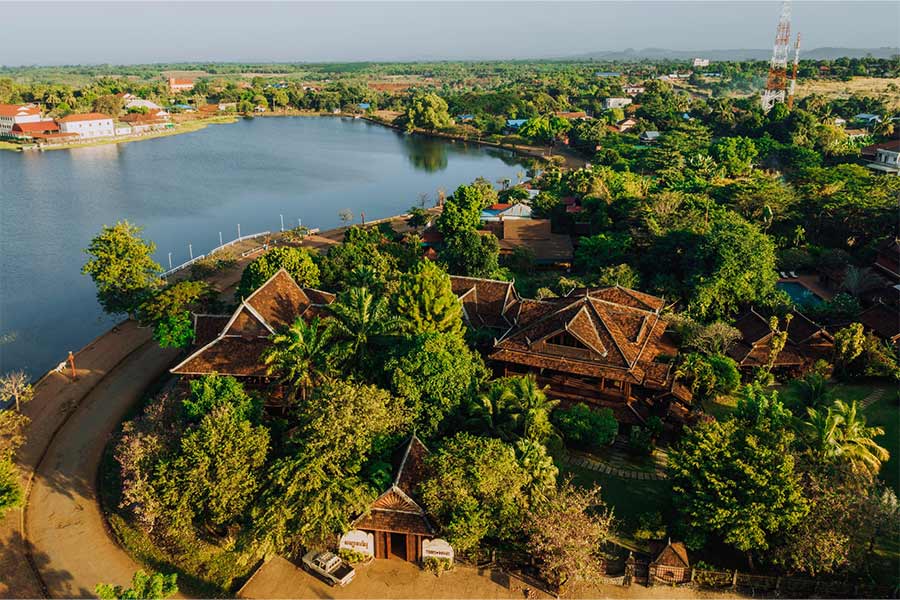
Maisons Wat Kor is the standout property: restored traditional wooden houses set in gardens outside the town center. Beautiful architecture, pool, excellent restaurant, and genuine character. It’s peaceful, well-managed, and captures colonial-era atmosphere authentically.
Classy Hotel & Spa in town center offers reliable mid-range comfort: clean modern rooms, pool, central location. It’s not charming but functional.
Bambu Hotel is newer boutique property with good design, helpful staff, and rooftop bar. Well-located and popular with independent travelers.
La Villa sits in restored colonial villa: atmospheric, breakfast is excellent, and the setting captures Battambang’s architectural heritage.
Where to Eat
Jaan Bai restaurant, run by Phare Ponleu Selpak, serves excellent Cambodian cuisine with contemporary presentation. The food is legitimately good, not just charity dining, and proceeds support the arts school.
Nary Kitchen does traditional Khmer food in home setting: amok, lok lak, and regional dishes. Family-run, authentic flavors, reasonable prices.
Riverside restaurants and street food stalls serve local specialties: num banh chok (Khmer noodles), grilled fish, and soups.
Western food is available at cafes like Cafe Eden and Lonely Tree Cafe, both serving decent coffee, breakfast, and mixed menus.
Getting There
From Siem Reap: 170 kilometers, roughly 3 hours by road (improved highway). Buses run multiple times daily ($6-8 USD), or private car takes similar time with more comfort.
From Phnom Penh: 290 kilometers, about 5-6 hours by bus or private car on decent highway.
By boat from Siem Reap: Some travelers still take the river boat, though this has declined as roads improved. It’s scenic but takes 6-8 hours (or more if water is low), can be uncomfortable, and costs more than buses.
By train: Cambodia’s railway now connects Phnom Penh to Battambang (and eventually will reach Poipet/Thai border). The service is slow but scenic and offers different perspective. Not yet reliable for time-sensitive travel.
When to Go
November through March: Dry season, cooler temperatures, and best conditions for cycling and countryside exploration. This is peak season though Battambang never gets crowded by Siem Reap standards.
April through May: Hot. Temperatures exceed 35°C regularly. Cycling and temple climbing are uncomfortable. Rice paddies are dry and less photogenic.
June through October: Rainy season. Afternoon storms are common, roads can get muddy in countryside, but mornings are often clear. Rice paddies are green and being worked, creating attractive landscapes. Significantly fewer tourists.
Planning Your Time
Two days and one night is minimum: arrive afternoon, explore town and evening circus performance, next day countryside cycling and temples, depart afternoon or evening.
Three days and two nights allows more relaxed pace: separate days for cycling, temples, countryside villages, and town exploration without rushing.
Battambang works well as a stop between Siem Reap and Phnom Penh (or Thailand via Poipet), breaking up the journey with genuinely interesting content rather than just being a transit point.
The Reality
Battambang doesn’t have blockbuster attractions. The temples are modest compared to Angkor. The bamboo train is a brief novelty. The colonial architecture is atmospheric but not monumental.
What Battambang offers is cumulative: pleasant provincial town, accessible countryside, affordable activities, and authentic Cambodian character without tourist crowds. It’s Cambodia at a human scale.
We recommend Battambang to clients who have time for Cambodia beyond just Angkor Wat, who appreciate understated charm over spectacular sights, and who want to see ordinary Cambodian life rather than just temples and beaches.
It’s particularly good for travelers who enjoy cycling, who want to slow down after intensive temple touring in Siem Reap, or who are building comprehensive Cambodia itineraries that show the country’s diversity.
Battambang won’t wow you with drama. But it rewards curiosity, offers pleasant days rather than exhausting sightseeing, and shows Cambodia that most tourists miss entirely. For travelers who can appreciate that kind of experience, Battambang delivers exactly what it promises: authentic, accessible, and genuinely Cambodian.
TOURS INCLUDE Battambang
OTHER DESTINATIONS



What customers say about us
VIDEO TESTIMONIALS
Robert
 ITALY
ITALY
 2019
2019
 REQUEST A FREE QUOTE