Tay Ninh
Tay Ninh: Vietnam’s Spiritual Frontier
Tay Ninh sits 90 kilometers northwest of Ho Chi Minh City, right against the Cambodian border. This provincial capital would be entirely unremarkable except for one extraordinary feature: the Cao Dai Great Temple, headquarters of Caodaism, Vietnam’s unique syncretic religion. Most visitors come for this temple alone, arriving from Ho Chi Minh City for a few hours before departing. That’s sufficient for seeing the main attraction, though the province contains more for those interested in Vietnam War history or natural areas along the border.
Cao Dai Religion and the Great Temple
Caodaism was founded in 1926, blending Buddhism, Taoism, Confucianism, Christianity, and Islam into a single faith. The religion’s symbol is the Divine Eye (representing God), and its pantheon includes saints ranging from Buddha and Jesus to Victor Hugo and Sun Yat-sen. It sounds bizarre, and visually, it absolutely is.
The Cao Dai Great Temple in Tay Ninh city is the religion’s Vatican: headquarters, main place of worship, and architectural spectacle. Built between 1933 and 1955, the temple combines European church design with Asian pagoda elements and vivid colors that defy any traditional religious aesthetic.
The exterior is pink and turquoise with ornate towers. Dragon-wrapped columns line the entrance. Inside, the nave stretches 65 meters, supported by columns painted in bright colors and decorated with dragons and clouds. The Divine Eye watches from the altar at the far end. The ceiling is painted celestial blue with clouds and stars.
It’s surreal, overwhelming, and genuinely unique. Nothing else looks remotely like this temple. Photography is permitted outside ceremonies, and the visual impact is immediate.
Attending a Ceremony
The real reason to visit is attending one of the daily prayer services. Cao Dai priests in colorful robes (white, red, blue, and yellow representing different ranks and virtues) conduct ceremonies four times daily: 6:00 AM, noon, 6:00 PM, and midnight.
The noon ceremony is most accessible for day-trippers. Worshippers enter through side doors (tourists watch from the balcony or sides of the main hall) and sit in segregated sections: men on the right, women on the left, according to rank.
The ceremony involves chanting, prayers, and ritual movements. Musical instruments accompany the prayers. The priests process down the central aisle in their elaborate robes. The visual spectacle of hundreds of white-robed followers against the psychedelic interior creates striking images.
Services last about 45 minutes. Visitors must observe quietly from designated areas. Remove shoes before entering. Dress modestly (shoulders and knees covered). Photography is allowed but be discreet and respectful.
The ceremony is genuine worship, not performance. This is an active religion with approximately 4 million followers, primarily in southern Vietnam. Treating it with respect rather than just as a tourist curiosity is essential.
Beyond the Temple
Most tours stop only at the Cao Dai Temple, spending 2-3 hours in Tay Ninh before returning to Ho Chi Minh City. The province contains other sites that extend the visit for those interested.
Black Virgin Mountain (Nui Ba Den)
This 986-meter peak rises dramatically from the flat landscape 15 kilometers northeast of Tay Ninh city. It’s a pilgrimage site with multiple pagodas built into the mountainside.
A cable car now runs to near the summit, eliminating the strenuous climb. At the top: pagodas, shrines, views across the province into Cambodia, and crowds of Vietnamese pilgrims and tourists.
The mountain has military significance from the Vietnam War. American and Viet Cong forces both used it strategically. Some war remnants remain visible.
Black Virgin Mountain is visually striking from a distance: an isolated peak rising from plains. Up close, the religious complex is busy and commercialized. It’s worth seeing if you’re already in Tay Ninh and have extra time, but not essential.
Cu Chi Tunnels
While technically in Cu Chi district (closer to Ho Chi Minh City), many tours combine Cu Chi Tunnels with Tay Ninh since they’re in the same direction from the city.
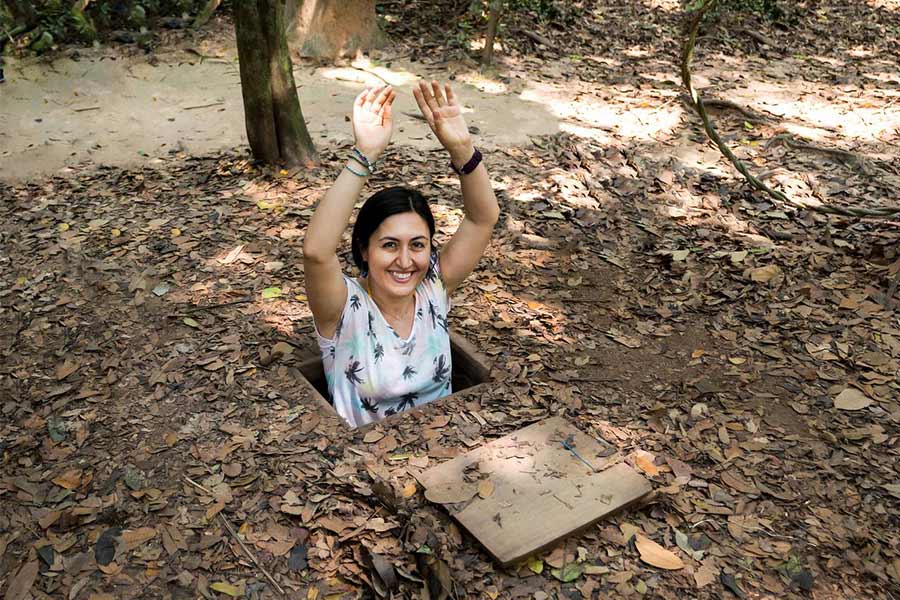
The tunnels are the famous Viet Cong underground network used during the war. You can crawl through sections, see trapdoors and hidden entrances, and learn about the tunnel system’s role in the conflict.
Ben Dinh and Ben Duoc are the two tourist sites. Ben Duoc is further from Ho Chi Minh City but less crowded and more authentic.
This combination (Cu Chi Tunnels morning, Cao Dai Temple noon ceremony, return to Ho Chi Minh City afternoon) is the standard day tour format.
Dau Tieng Lake
Vietnam’s largest freshwater reservoir sits about 40 kilometers from Tay Ninh. It’s scenic, with forested shores and islands. Some fishing and boat activities operate, but tourism infrastructure is limited.
It’s too far and undeveloped to include in standard Tay Ninh visits. Mention it only for completeness.
Where to Eat
Tay Ninh’s specialty is bánh canh Trảng Bàng (thick noodle soup) from the nearby district. Several restaurants in Tay Ninh city serve it: clear broth, thick tapioca noodles, pork, and fresh herbs. It’s worth trying if you’re having lunch in the area.
Most tours include lunch at pre-arranged restaurants. Quality is acceptable but unremarkable.
Street food stalls around the market serve standard Vietnamese dishes at local prices.
Where to Stay
Almost no international tourists stay overnight in Tay Ninh. The city has basic hotels (Hoa Binh Hotel, Tay Ninh Hotel) adequate for Vietnamese business travelers but nothing appealing for leisure tourists.
If you need accommodation, stay in Ho Chi Minh City and day-trip to Tay Ninh instead.
Getting There
From Ho Chi Minh City: 90 kilometers northwest, roughly 2-2.5 hours by road.
Private car offers flexibility and comfort. We arrange these for clients wanting to control timing, particularly for arriving at the noon ceremony.
Buses run regularly from the western bus station to Tay Ninh (around 60,000 VND). From Tay Ninh bus station, the Cao Dai Temple is about 5 kilometers (xe om or taxi).
Organized tours are the most common option: bus picks you up from hotels, drives to Tay Ninh (often via Cu Chi Tunnels), attends noon ceremony, returns to Ho Chi Minh City. Cost around $20-30 USD including transport, guide, and usually lunch.
Tours are efficient and eliminate logistics. Private arrangements offer more flexibility but cost more.
Timing Your Visit
Arrive at least 30 minutes before the noon ceremony (by 11:30 AM) to get good viewing positions. Tour groups arriving at 11:50 AM end up at the back with obstructed views.
The ceremony starts precisely at noon and lasts about 45 minutes. Afterward, you can explore the temple more thoroughly and photograph the interior without crowds.
Early morning (6:00 AM) ceremony sees fewer tourists but requires very early departure from Ho Chi Minh City.
Evening (6:00 PM) ceremony works if you’re staying overnight or don’t mind late return to the city.
Midnight ceremony is impractical for most visitors.
Combining with Cu Chi
The standard combination is Cu Chi Tunnels morning (arrive around 8:00 AM, spend 2-3 hours), drive to Tay Ninh, arrive for noon ceremony, lunch afterward, return to Ho Chi Minh City by 4:00-5:00 PM.
This makes a full day but isn’t rushed. Both sites are worthwhile, and combining them is logistically sensible given their direction from Ho Chi Minh City.
Some tours reverse the order: Cao Dai Temple early morning ceremony, then Cu Chi Tunnels after. This works but means missing the more accessible noon ceremony.
When to Go
Tay Ninh is visitable year-round. The temple doesn’t depend on seasons.
Dry season (November-April) offers more reliable weather and comfortable temperatures.
Wet season (May-October) brings afternoon rain, but the morning ceremony (6:00 AM) and noon ceremony usually finish before storms.
Weekdays see slightly fewer tour groups than weekends, though the temple gets steady visitors throughout the week.
The Reality
The Cao Dai Great Temple is genuinely worth seeing. The architecture is unique, the ceremony is visually spectacular, and the religion itself is fascinating as a Vietnamese response to colonialism and religious plurality.
But Tay Ninh city offers little beyond the temple. It’s a border town with limited appeal. The temple justifies a half-day visit but not longer stays.
We consistently recommend Tay Ninh to clients visiting Ho Chi Minh City who have at least 3-4 days in the south. It’s one of the region’s most distinctive attractions, easily accessible as a day trip, and different from anything else in Vietnam.
The combination with Cu Chi Tunnels makes particular sense: you get war history and unique religious culture in one efficient day trip. Both sites are strong individually and complement each other thematically (both show Vietnamese responses to conflict and outside influence, though in very different ways).
Just understand you’re going specifically for the Cao Dai Temple and ceremony. Everything else is supplementary. The temple delivers exactly what it promises: a unique visual and cultural experience unlike anything else in Southeast Asia.
Set aside 4-5 hours minimum for the round trip from Ho Chi Minh City plus time at the temple. A full day if combining with Cu Chi Tunnels. That investment is worthwhile for seeing one of Vietnam’s most unusual and photogenic religious sites.
TOURS INCLUDE Tay Ninh
OTHER DESTINATIONS


What customers say about us
VIDEO TESTIMONIALS
Robert
 ITALY
ITALY
 2019
2019
 REQUEST A FREE QUOTE