Hoa Lu
Hoa Lu: Vietnam’s First Capital
Hoa Lu sits in Ninh Binh Province, 100 kilometers south of Hanoi. This was Vietnam’s capital from 968 to 1010 AD under the Dinh and Early Le dynasties. For those 42 years, this small valley surrounded by limestone karsts served as the political and military center of the newly independent Vietnamese state after a thousand years of Chinese domination.
Almost nothing remains of the original city. What you see today are 17th-century temples built on the foundations of the ancient royal palaces. But the location itself, the strategic thinking behind choosing this site, and the historical significance make Hoa Lu worth understanding, even if the physical remnants are limited.
The History That Matters
In 968, Dinh Bo Linh unified the country and established the Dinh dynasty, taking the title Emperor Dinh Tien Hoang. He chose Hoa Lu as his capital for defensive reasons: the valley is surrounded by limestone mountains on three sides, with only narrow passages in and out. It was easier to defend against potential Chinese invasion than an open delta location.
The kingdom was fragile, newly independent, and constantly threatened. Hoa Lu’s geography provided natural fortifications that more accessible locations couldn’t offer.
In 980, Le Hoan seized power and founded the Early Le dynasty, keeping Hoa Lu as capital. By 1010, Ly Thai To moved the capital to Thang Long (now Hanoi), which had better access to waterways and more room for expansion. Hoa Lu was abandoned as a political center.
Over centuries, the original palaces and fortifications deteriorated. In the 17th century, local authorities rebuilt two temples on the royal palace sites to honor the Dinh and Le emperors.
The Two Main Temples
Dinh Tien Hoang Temple sits on the foundation of the original Dinh dynasty palace. The current structure dates from 1696. It’s relatively small, built in traditional Vietnamese temple style with multiple courtyards, carved wooden pillars, and ornate decoration.
Inside, statues honor Emperor Dinh Tien Hoang, his three sons, and key officials from his court. The architecture is well-preserved, and the setting against limestone mountains is photogenic.
Le Hoan Temple (also called Anterior Le Temple) sits about 500 meters away, dedicated to Emperor Le Hoan. Similar architecture, slightly smaller scale. The approach involves a pleasant walk through rice fields and past lotus ponds.
Both temples function as active religious sites. Local people come to pray and make offerings, particularly during festivals. This adds authenticity beyond just historical tourism.
The Landscape
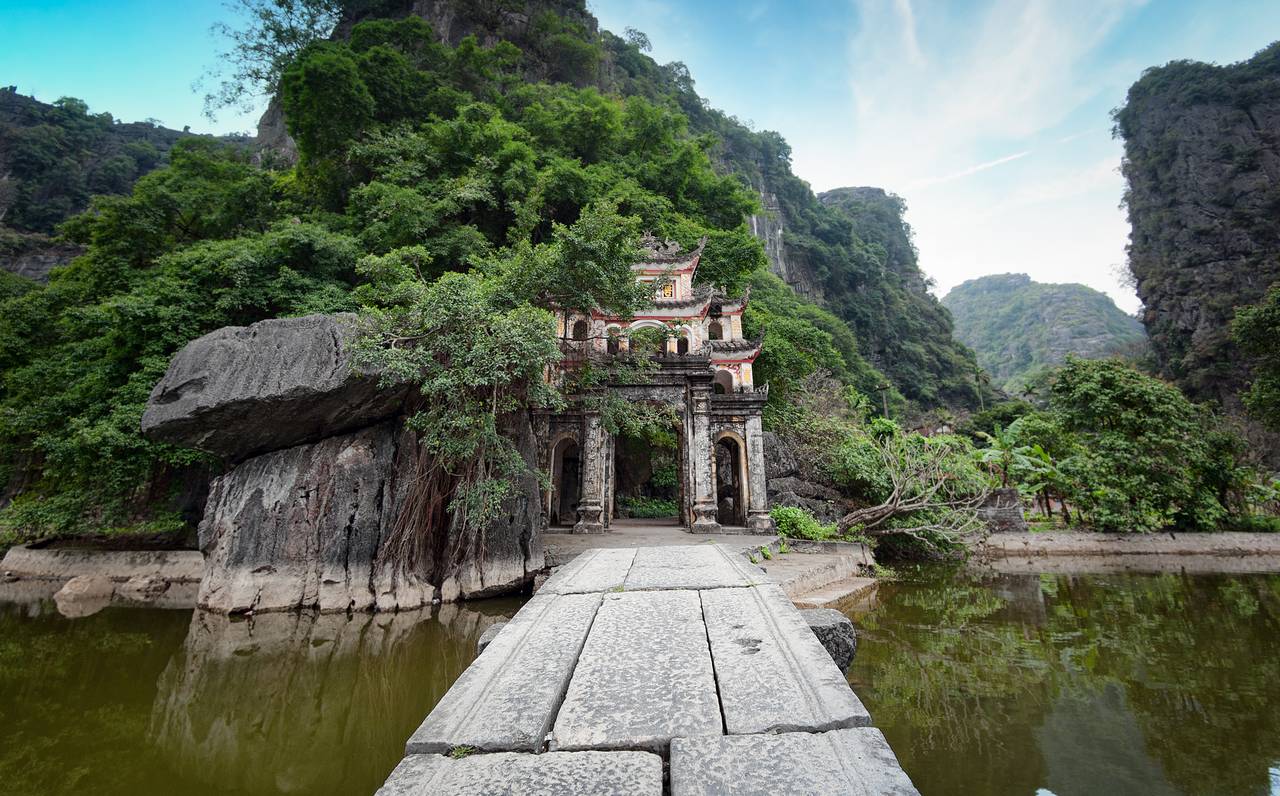
Hoa Lu’s real appeal is the setting. The limestone karsts here are similar to Tam Coc and Trang An (both nearby), creating dramatic backdrops to the temples and rice fields.
Walking between the two temples takes you through rural landscape: rice paddies, small villages, water buffalo, and farmers working fields. This context shows why the area was strategically valuable but also why it couldn’t support a growing capital city long-term.
The surrounding mountains contain caves that served as defensive positions and supply storage during the 10th century. Some are accessible, though most tourists skip them in favor of the more developed cave systems at Tam Coc and Trang An.
Visiting Practically
Entry costs 20,000 VND (roughly €0.75) for the site covering both temples.
Plan 1-2 hours for both temples and walking between them. That’s sufficient unless you want to explore surrounding areas more thoroughly.
Dress modestly for temple visits: shoulders and knees covered.
The site gets busy with domestic tour groups, especially weekends and holidays. Early morning (8:00-9:00 AM) or late afternoon sees fewer crowds.
Guides can provide historical context that makes the temples more meaningful. Without explanation, they look like typical Vietnamese temples. Understanding their historical significance and strategic location adds depth.
Combining with Nearby Sites
Hoa Lu is almost never visited alone. It’s universally combined with Tam Coc, Trang An, or both, creating a full day trip from Hanoi or an itinerary across Ninh Binh Province.
Tam Coc (6 kilometers from Hoa Lu) offers boat trips through rice paddies and limestone caves. The rowing boats take about 2 hours round trip through stunning scenery. This is Ninh Binh’s most popular activity.
Trang An Scenic Landscape Complex (8 kilometers from Hoa Lu) is a UNESCO World Heritage site with boat routes through caves and karst formations. It’s larger and more developed than Tam Coc but equally beautiful.
Bich Dong Pagoda sits on a limestone cliff near Tam Coc. Three levels of pagodas built into the mountainside, reached by stone steps. Takes 30-45 minutes to visit.
Mua Cave viewpoint involves climbing 500 steps for panoramic views across Tam Coc’s landscape. The view is exceptional, justifying the climb. Plan 45-60 minutes.
Most day trips from Hanoi follow this pattern: Hoa Lu temples in the morning, lunch in the area, then Tam Coc boat trip or Trang An in the afternoon. It’s a full day but not rushed.
Where to Eat
Restaurants cluster along the road between Hoa Lu and Tam Coc, catering to tour groups. Quality varies significantly.
Goat meat is a regional specialty. Restaurants advertise de (goat) cooked various ways: grilled, stir-fried, in hot pot. It’s legitimately popular with Vietnamese visitors, not just tourist marketing.
We direct clients to specific restaurants we’ve verified for cleanliness and quality. Random selection can lead to overpriced, mediocre meals.
Many tours include lunch as part of the package. Check what’s included before booking.
Getting There
Ninh Binh Province is 100 kilometers south of Hanoi. Hoa Lu specifically is about 12 kilometers from Ninh Binh city.
By private car from Hanoi: 2-2.5 hours depending on traffic. This is the most comfortable option and allows flexibility for multiple sites.
By train to Ninh Binh station: 2 hours on faster trains, 2.5-3 hours on slower ones. From the station, you’ll need transport to Hoa Lu (taxi, xe om, or arranged pickup). Trains are cheap and reliable but add logistical steps.
We arrange private cars for clients, building custom itineraries across Ninh Binh that move at your pace rather than group timing.
Staying in Ninh Binh
Most visitors day-trip from Hanoi, but staying overnight in Ninh Binh lets you explore more thoroughly and avoid the crowds that arrive mid-morning from the capital.
Tam Coc Garden Resort offers boutique accommodation among rice fields. Well-designed bungalows, good restaurant, peaceful setting.
Emeralda Ninh Binh Resort is larger and more resort-like. Pool, spa, multiple restaurants. Comfortable but less character.
In mid-range standard, you might consider Le Clos du Fil Hotel; Tam Coc Villas, Chez Loan Guesthouse
When to Go
May through June: Rice is bright green after planting. The landscape is lush and photogenic.
September through October: Harvest season brings golden rice fields. This is the most beautiful period visually.
November through April: Dry season with clearer skies. Rice fields are less colorful post-harvest but weather is more reliable.
June through August: Hot and potentially wet. Still visitable but less comfortable.
Weekdays see fewer domestic tourists than weekends. If you have flexibility, visit Monday through Thursday.
The Reality
Hoa Lu’s temples aren’t architecturally exceptional compared to other Vietnamese temples. The historical significance is the main value, and that requires context to appreciate.
Many visitors feel underwhelmed by Hoa Lu because they expected more visible ruins or grander structures. Understanding what you’re seeing (17th-century temples on 10th-century foundations marking Vietnam’s first capital) versus what you’re not seeing (the original city, which has disappeared) manages expectations appropriately.
We recommend Hoa Lu as part of a Ninh Binh day trip, not as the primary destination. The temples provide historical context and a pleasant morning activity before the more visually impressive boat trips at Tam Coc or Trang An.
If you’re particularly interested in Vietnamese history and the post-independence period, Hoa Lu has real significance. If you’re primarily interested in scenery and activities, spend more time at Tam Coc or Trang An and treat Hoa Lu as a brief stop for context.
The combination of all three (Hoa Lu for history, Tam Coc or Trang An for scenery and boats, Mua Cave for views) creates a comprehensive Ninh Binh experience. That full-day itinerary balances culture, nature, and activity in ways that make the region one of northern Vietnam’s most popular destinations.
Just understand that Hoa Lu itself is the historical appetizer, not the main course.
TOURS INCLUDE Hoa Lu
OTHER DESTINATIONS
















What customers say about us
VIDEO TESTIMONIALS
Robert
 ITALY
ITALY
 2019
2019
 REQUEST A FREE QUOTE