Golden Triangle
The Golden Triangle: Where Three Nations Meet
The Golden Triangle is the region where the borders of Thailand, Laos, and Myanmar converge at the confluence of the Ruak and Mekong rivers in far northern Thailand. The closest town is Chiang Rai, about 70 kilometers south. The area has become synonymous with opium production—historically one of the world’s largest drug-producing regions—though that legacy is complicated, shifting, and often misunderstood by casual visitors.
Today, the Golden Triangle exists as both a genuine geographical and cultural crossroads and a carefully packaged tourist attraction. The actual border region is relatively quiet, with small villages, riverside scenery, and a few dedicated museums examining the opium trade. But the name carries historical weight that draws travelers seeking to understand Southeast Asian geography, drug trafficking history, and the complex politics of remote borderlands. Much of what you’ll find here is genuine; some of it is theatrical. Understanding the difference matters before you visit.
Geography and Location
The Golden Triangle is not a town—it’s a region defined by where three national borders meet.
- The Ruak River forms the Thailand-Myanmar border.
- The Mekong River forms the Thailand-Laos border.
- These rivers meet at a sharp angle, creating a triangular wedge of territory.
The heart of the triangle sits on the Laotian side of the Mekong, technically inaccessible to casual tourists without crossing into Laos. What most visitors see is the Thai side of the rivers, looking toward the other countries.
Chiang Rai is the main hub, roughly 1.5 hours’ drive south. It’s a modest but livable city with hotels, restaurants, tour operators, and basic facilities—much more comfortable than the remote Golden Triangle itself.
The border towns directly at the triangle—places like Mae Sai (on the Thailand-Myanmar border) and Chiang Khong (on the Thailand-Laos border, though slightly removed from the triangle’s apex)—are small, dusty, frontier settlements with a frontier feel: duty-free shops, border crossing energy, and a sense of economic activity tied to cross-border trade.
The Opium Trade History
Understanding the Golden Triangle requires grappling with the opium trade, which shaped the region for centuries and continues to influence its identity today.
Historical context
From the 19th century onward, opium was a major cash crop across Southeast Asia. The British and French colonial powers encouraged or tolerated production. Local populations—particularly hill tribes in the mountains of northern Thailand, Laos, and Myanmar—cultivated poppies because they grew well at altitude and provided reliable income in regions with limited market access.
By the mid-20th century, the Golden Triangle (encompassing parts of all three countries) had become the world’s largest opium-producing region, potentially accounting for 50–70% of global illicit opium. Production peaked in the 1980s and 1990s.
The mechanics of the trade
The opium economy was never simple peasant farming. It involved:
- Hill tribe farmers growing poppies in remote highlands.
- Local traders buying the raw opium.
- Trafficking networks moving it through Laos and Thailand toward Thailand’s central plains and eventually international markets.
- Warlords, military officers, and organized crime figures controlling production and trafficking routes.
- Money laundering and corruption integrating drug proceeds into legal economies.
The trade was intimately tied to regional power structures. Military governments, ethnic militias, and intelligence agencies all profited from or enabled opium trafficking. Corruption was systemic; enforcement was selective and often involved powerful players protecting their interests while cracking down on competitors.
The Secret War connection
During the Vietnam War and immediately after, the CIA allegedly supported or tolerated opium trafficking by Hmong allies in Laos to fund anti-communist operations. This remains controversial, with declassified documents supporting some claims while denying others. The general consensus is that opium money flowed freely through American-aligned networks during the war years, though the extent of direct CIA involvement remains debated.
What’s clear: the post-war period saw massive opium production spike as regional instability created space for trafficking.
Decline and shift
Opium production in the Golden Triangle has declined dramatically since the 1990s due to:
- Thai government crop substitution programs offering hill tribes alternative cash crops (coffee, tea, fruits).
- Increased enforcement and international pressure.
- Myanmar’s junta cracking down on production in areas under their control (though this was inconsistent).
- Market shifts toward heroin and synthetic drugs like methamphetamine, which don’t require poppy cultivation.
- Economic development making subsistence farming less necessary for some communities.
Today, opium production still occurs in remote areas of Myanmar and Laos, but at a fraction of historical levels. The region has not been eliminated as a drug source—methamphetamine production in Myanmar has actually expanded—but the visible opium economy that once dominated the highlands has largely faded.
What You Actually See and Do
Most travelers visit the Golden Triangle expecting to see poppy fields or drug manufacturing. Instead, they find:
The Golden Triangle Park (Sop Ruak)
The main tourist hub sits at the apex where the rivers meet, centered around a small town called Sop Ruak on the Thai bank. The “park” is essentially a manicured riverside area with viewpoints, a few restaurants, and shops.
- You can stand on Thai soil and literally look across the Ruak River to Myanmar and across the Mekong to Laos. On clear days, you can see hills, villages, and sometimes smoke from cooking fires on the opposite banks.
- The view is interesting but not dramatically scenic—the rivers are not spectacular, the opposite banks look rural and unremarkable, and the triangle itself is mundane.
- There are benches, a few small monuments and signs, and photo opportunities with maps showing the three borders.
Visiting takes 20–30 minutes. The reality is much less exotic than the name suggests.
Hall of Opium (Opium Museum)
This is the primary museum at Sop Ruak, dedicated to the history of opium in Southeast Asia.
- The museum occupies a modern building and includes exhibits on poppy cultivation, traditional opium smoking, trafficking routes, and the region’s role in the global drug trade.
- Exhibits include pipes, weights and scales used for dealing, photographs of poppy fields, and explanations of how opium was processed into heroin.
- There are also sections on the history of drug control efforts, crop substitution programs, and the decline of opium production.
- A small gift shop sells books and documentaries about the subject.
The museum is actually quite well-done—informative, balanced, and neither sensationalized nor whitewashed. It takes the history seriously and explains the complexity rather than reducing it to simple narratives.
Plan 1–1.5 hours here. If you’re interested in the drug trade and regional history, it’s worthwhile. If opium history doesn’t interest you, skip it.
House of Opium (alternative/private museum)
A smaller, less-developed competitor museum also exists, typically with lower standards and more sensationalism. The Hall of Opium is the better option.
River activities
- You can arrange boat trips on the Mekong, floating past Laotian villages and fishing boats. These are pleasant but unspectacular—the river is wide and muddy, villages are distant across the water, and the experience feels more touristy than adventurous.
- Long-tail boat operators offer similar services; the boats are cramped and uncomfortable for extended periods.
- Some tours include riverside lunch or drinks, which adds ambiance but doesn’t fundamentally alter the experience.
Border crossings (brief visits)
- You can cross into Laos or Myanmar for very brief visits (a few hours) via official border crossings.
- Crossing into Laos at Chiang Khong and returning the same day is relatively straightforward; you’ll need a valid passport.
- Crossing into Myanmar is more restricted and requires pre-arranged visas or special permits in most cases.
- Most tourists do not actually cross; they simply view the borders from the Thai side.
Shopping and duty-free
- The border towns of Mae Sai and Chiang Khong have duty-free zones with shops selling alcohol, cigarettes, and handicrafts at discounted prices.
- If you’re interested in Lao or Myanmar crafts, these can be worth browsing, though quality and authenticity vary.
- Much of what’s sold is mass-produced souvenir material rather than genuine artisanal work.
Nearby Attractions
The Golden Triangle itself is modest; most travelers combine it with other northern Thailand experiences.
Chiang Rai city
About 70 kilometers south, Chiang Rai is the regional hub and offers more to see and do than the border area itself.
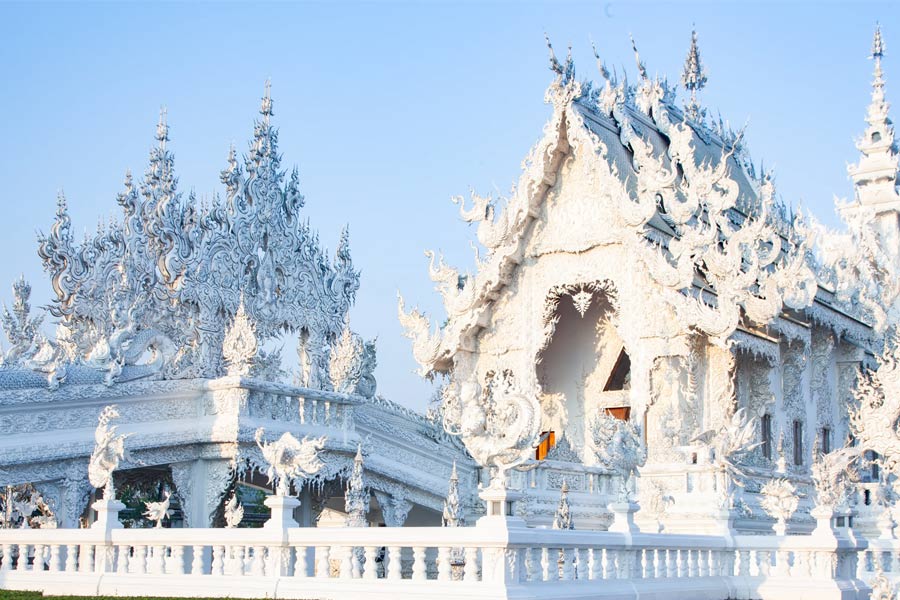
- The White Temple (Wat Rong Khun) is Chiang Rai’s most famous attraction: an unconventional, all-white modern Buddhist temple designed by artist Thawan Duchanee. It’s visually striking, crowded with tourists, and worth 30–45 minutes.
- The Blue Temple (Wat Rong Suea Ten) is a similarly contemporary temple with intense blue interiors. Less crowded than the White Temple, equally photogenic.
- The Old City has a night bazaar (night markets) with food stalls, handicrafts, and local energy. It’s touristy but lively, especially for dinner.
- Several smaller temples dot the city; Wat Phra Singh is historically significant and less touristy than the white and blue temples.
Chiang Rai is a reasonable base: more comfortable and with more options than staying directly at the Golden Triangle, with easy day trips to the border area.
Trekking and hill tribe villages
From Chiang Rai, you can arrange treks to hill tribe villages in the surrounding mountains. These experiences vary widely in quality and ethics.
- Reputable operators work with specific communities, employ local guides, and ensure income benefits villagers.
- Lower-quality operators run exploitative “human zoo” experiences where tourists gawk at villagers like exhibits.
If you’re interested in trekking and meeting hill tribe communities (Hmong, Karen, Lisu, and others), choose your operator carefully. Ask specific questions about where money goes, whether villages are pre-arranged photo stops or genuine visits, and whether guides are from the communities themselves.
Doi Tung
A mountain area north of Chiang Rai with a royal palace, botanical gardens, and scenic views. It’s a pleasant half-day trip for those interested in mountain scenery rather than border geopolitics.
Mae Salong (Santikhiri)
A mountain village with a mix of Chinese (Yunnanese) heritage, tea plantations, and cooler temperatures. It offers an alternative to the border focus and some genuinely interesting cultural history tied to Chinese migration and the opium trade. The town has developed into a modest hill station with guesthouses, restaurants, and scenic overlooks.
Practicalities
Getting there
From Chiang Rai, the Golden Triangle is about 70 kilometers north, roughly 1.5 hours by car or minibus. Organized tours depart daily from Chiang Rai, typically costing $20–40 USD for a half or full day, including transport, guide, and sometimes lunch.
Private car rental with driver is available through hotels or tourist operators; expect to pay $30–50 USD for a day.
From Bangkok, you’d fly to Chiang Rai (about 1.5–2 hours) and then arrange transport to the Golden Triangle. Most visitors arrive in Chiang Rai first.
Accommodation
There is minimal accommodation directly at the Golden Triangle itself. The only option is:
- Golden Triangle Park Resort: A mid-range hotel right at Sop Ruak with river views. Clean, functional, comfortable but overpriced for what’s offered. Most travelers use it as a lunch stop rather than an overnight base.
Staying in Chiang Rai is much more practical, with dozens of hotels ranging from budget guesthouses ($10–20 USD) to mid-range chains ($30–60 USD) to upscale resorts ($80+ USD). From Chiang Rai, you can easily day-trip to the Golden Triangle.
Meals
At the Golden Triangle itself, there are a few riverside restaurants serving standard Thai food and tourist-oriented menus. Quality is mediocre and prices inflated due to captive tourism.
Chiang Rai has far better restaurant options: authentic Thai cuisine in the night bazaar, international chains, and family-run establishments with reasonable prices.
Timing
Most organized tours run half days (morning or afternoon, about 4–5 hours including transport) or full days (6–8 hours). Half days are adequate for viewing the triangle, visiting the museum, and taking a short boat trip. Full days allow more leisurely exploration and inclusion of other Chiang Rai attractions.
When to Go
November through February: Cool and dry
This is the best season for northern Thailand. Temperatures drop to pleasant levels (15–25°C in the mornings), humidity is low, and skies are clear. It’s also high tourist season, so the Golden Triangle will be more crowded and tour prices higher. Sunrise visits can be especially beautiful as mist clears from the rivers.
March through May: Hot and hazy
Heat builds significantly, and agricultural burning in neighboring Myanmar and Laos creates haze that reduces visibility across the rivers. Air quality can be poor. The experience is less visually appealing, but crowds thin somewhat.
June through October: Rainy season
Afternoon storms are common, the rivers swell, and visibility decreases. The landscape turns lush, and there are far fewer tourists. If you don’t mind occasional rain and want authentic experience without crowds, this works. Boat trips become less pleasant due to water levels and current.
The cool season (November–February) is ideal, but even then, expect crowds if visiting popular times.
The Reality: What to Expect
The Golden Triangle has a powerful name that carries historical and geopolitical weight. In the imagination, it’s exotic, dangerous, and dramatic. In reality, it’s much more mundane.
What you get:
- A geographical oddity: the actual point where three countries meet, which is genuinely interesting as a concept but visually unremarkable.
- A museum (Hall of Opium) that provides solid historical context on a significant regional issue.
- Pleasant river views and the sense of being at a border region.
- A functional day trip from Chiang Rai that adds geographic knowledge without consuming much time.
What you don’t get:
- Dramatic mountain scenery (the landscape is gently rolling, not spectacular).
- Active drug trade to witness (the opium economy has shifted and declined; you won’t see smuggling or trafficking).
- Dangerous frontier atmosphere (the Thai side is entirely safe, controlled, and touristy).
- Insight into current regional geopolitics or cross-border dynamics (the tourist zone is sanitized and peaceful).
The Golden Triangle works best as one component of a northern Thailand itinerary, not as a standalone destination. Combine it with:
- Chiang Rai’s temples (White Temple, Blue Temple).
- A trek to hill tribe villages if interested in communities and landscapes.
- Time in the old city and night bazaar for food and handicrafts.
- Possibly Mae Salong or other mountain areas for different perspectives.
Travelers who approach the Golden Triangle as a brief geographic curiosity with historical museum context usually find it worthwhile. Those expecting exotic danger or dramatic landscapes often leave disappointed. Manage expectations accordingly.
The opium history is real and significant—the region genuinely was a major drug-producing area with complex geopolitical dimensions. But that history is largely in the past, accessed through exhibits rather than lived experience. The present-day Golden Triangle is a peaceful, somewhat touristy, geographically interesting spot with a complicated historical narrative. It’s worth a few hours if you’re in Chiang Rai; it’s not worth traveling to Chiang Rai specifically to see.
TOURS INCLUDE Golden Triangle
OTHER DESTINATIONS
What customers say about us
VIDEO TESTIMONIALS
Robert
 ITALY
ITALY
 2019
2019
 REQUEST A FREE QUOTE